Run your hand along a hand block-printed cotton and you can almost feel the rhythm of the person who made it: carve, dip, press, lift, repeat. Block printing is one of the oldest ways of decorating cloth in the world, and in India it’s still a living craft, practised by families who have passed down techniques for generations. It’s also having a moment: many of the small labels we love are built around it.
How it works
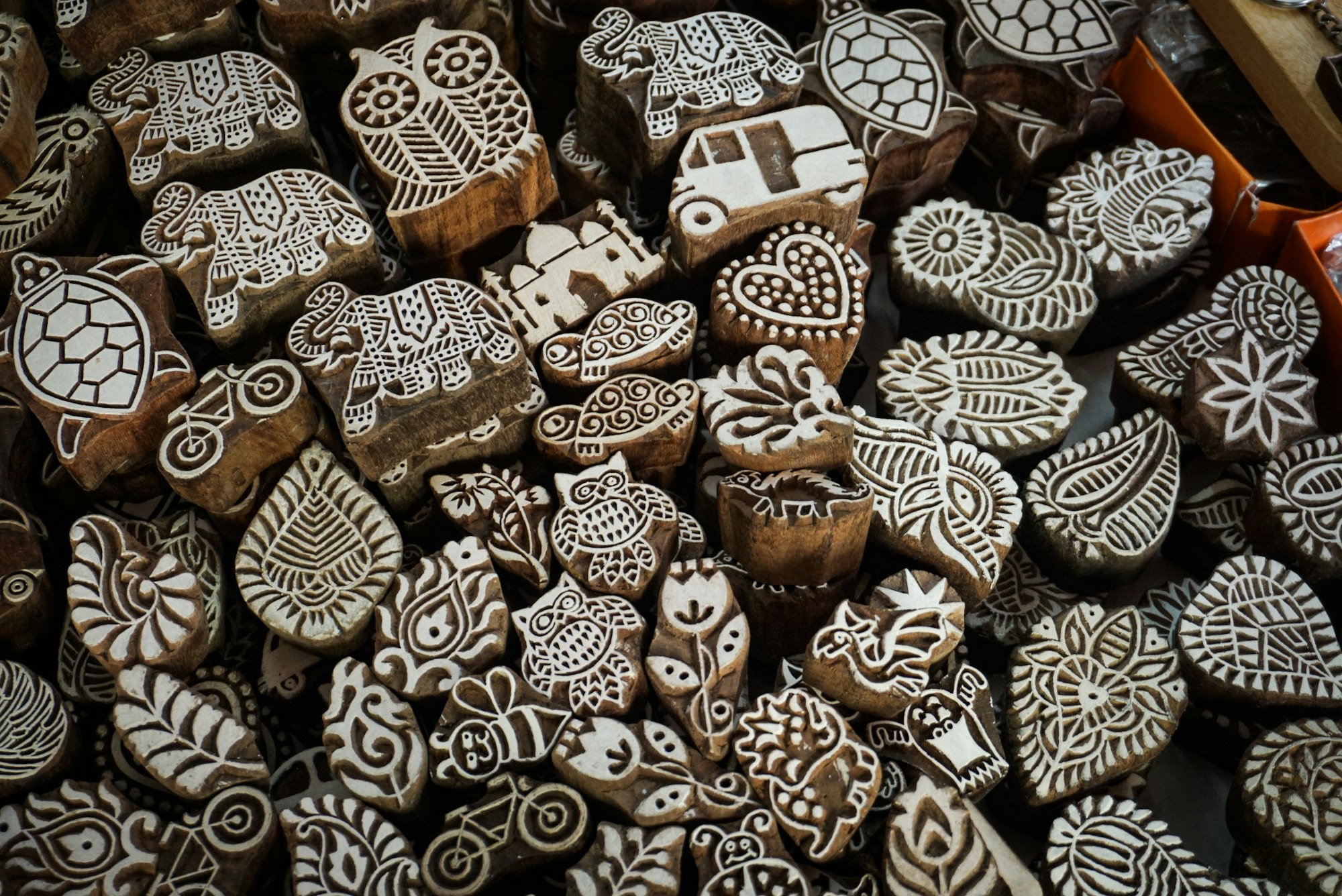
The process starts with a wooden block, traditionally hand-carved from teak or sheesham, with a design cut into its face. The printer dips the block in dye and presses it firmly onto fabric stretched across a long padded table, moving along the cloth one impression at a time. A multi-coloured design needs a separate block for each colour, lined up by eye, which is why even a simple print can take days.
Every small misalignment is a signature: proof that a person, not a machine, made the cloth.
A few styles worth knowing
- Sanganeri: from Sanganer, near Jaipur. Known for delicate floral motifs printed on light, often white, backgrounds.
- Bagru: from the village of Bagru, also near Jaipur. Traditionally earthier, with bold motifs in natural dyes on darker or off-white grounds, and closely linked with dabu, a mud-resist technique.
- Dabu: a resist method where a paste of mud, gum and lime is printed onto the cloth first. When the fabric is dyed, often in indigo, the covered areas stay pale, giving a soft, slightly cracked look.
- Ajrakh: associated with Kutch in Gujarat and with Sindh across the border. A complex, many-stage process of resist printing and natural dyeing, with deep indigo and madder-red geometric patterns.
Natural and synthetic dyes
Many traditional printers use natural dyes: indigo for blues, madder for reds, pomegranate rind and turmeric for yellows, iron for black. Others use synthetic dyes, which are brighter and more consistent. Neither is “wrong”, but if a label says natural dyes, it’s fair to ask which ones. Makers working with them are usually delighted to explain.
How to spot the real thing
- Look for small irregularities: slight overlaps, gaps or shifts where blocks meet. Perfect, machine-identical repeats suggest screen or digital printing.
- Check the back: hand block prints often show the dye bleeding through more softly on the reverse.
- Ask about the process: a genuine maker can tell you where the cloth was printed and by whom.
- Expect a fair price: real hand block printing is slow, skilled work. If a printed kurta costs less than a coffee, it almost certainly isn’t handmade.
Caring for block prints
Wash gently in cold water, separately for the first few washes, as natural dyes can release a little colour. Dry in the shade to keep the colours from fading, and iron on the reverse. Treated kindly, block-printed cotton softens beautifully with age.
Why it matters
Buying hand block-printed textiles, especially directly from small labels that work with printing families, helps keep the skill alive and the income in the communities that hold it. It’s fashion with a story you can actually trace.
Do you work with block printers or run a craft-led label? Tell us your story.
Photo: Kushali Bhagat / Unsplash